
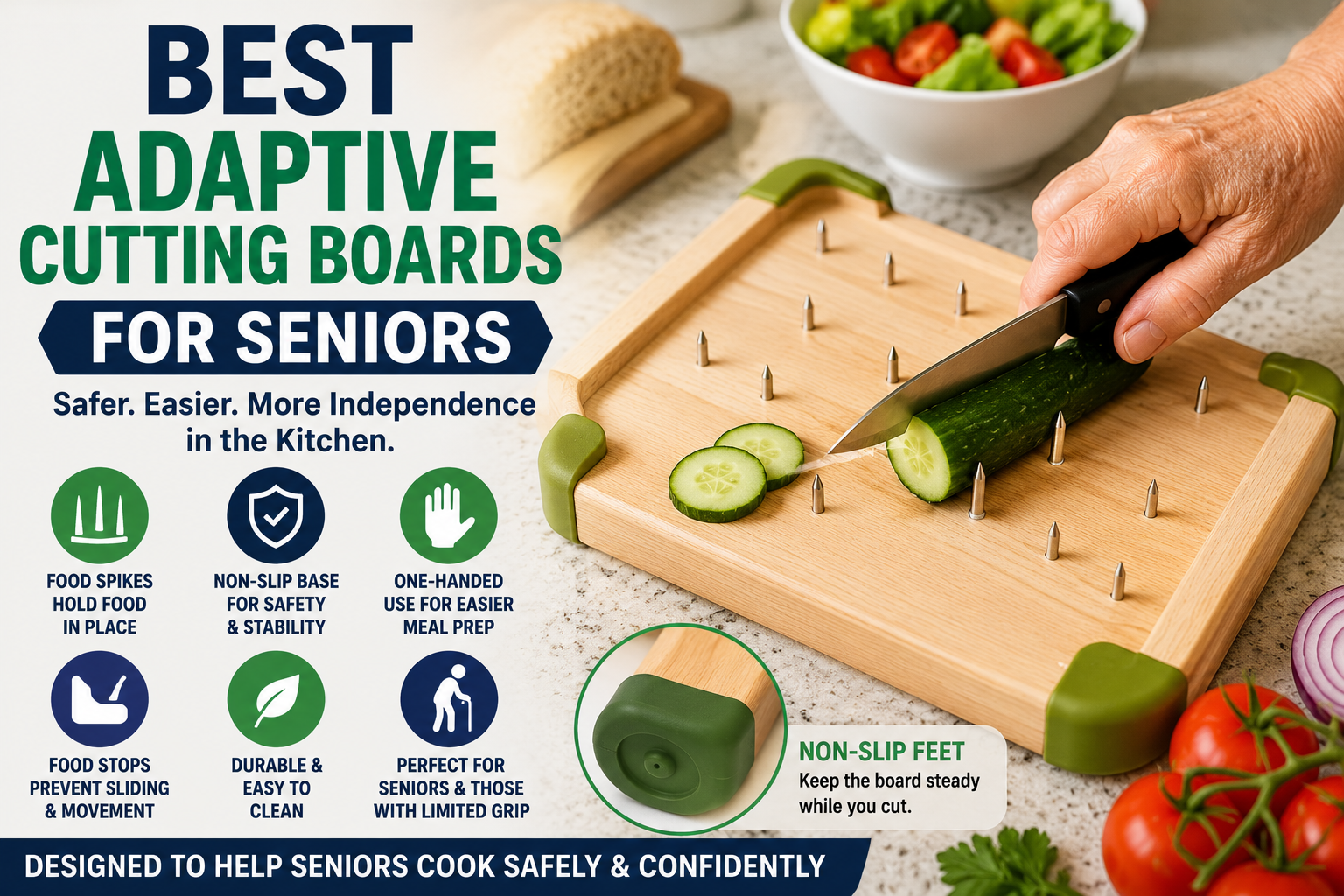
Best Adaptive Cutting Boards for Seniors
As an Amazon Associate, I earn from qualifying purchases.
An adaptive cutting board can make food preparation easier for seniors who have arthritis, weak hands, hand tremors, limited grip strength, or the use of only one hand.
The best adaptive cutting boards for seniors help hold food in place while cutting, slicing, peeling, or spreading. Many have food spikes, corner guards, non-slip feet, suction cups, or raised edges to help reduce slipping and make kitchen tasks safer.
Adaptive cutting boards also work well with other senior-friendly kitchen tools. You may also want to see our guides to best easy-grip utensils for seniors with arthritis, best jar openers for seniors with arthritis, best electric can openers for seniors with arthritis, and best non-slip placemats for seniors.
Quick Picks: Best Adaptive Cutting Boards for Seniors
| Product | Best For | Type |
|---|---|---|
| SENDAR Adaptive One-Handed Cutting Board | Best overall | Wooden board with spikes |
| Fanwer Adaptive One-Handed Cutting Board | Best all-around kitchen prep board | Board with spikes and food stops |
| Adaptive One-Handed Cutting Board with Anti-Slip Design | Best for stroke recovery or one-handed use | One-handed cutting board |
| Adaptive Cutting Board with Aluminum Spikes | Best simple classic option | Small adaptive board |
| One-Handed Adaptive Cutting Board with Spikes | Best lightweight option | Lightweight adaptive board |
Best Overall: SENDAR Adaptive One-Handed Cutting Board
The SENDAR Adaptive One-Handed Cutting Board is a strong overall choice for many seniors because it includes food spikes that help hold food in place while cutting or slicing.
This type of board can be helpful for seniors with arthritis, hand weakness, tremors, or limited use of one hand. The spikes help keep food from sliding around, which may make meal prep easier and less frustrating.
It may also be useful for stroke survivors, people recovering from injury, or caregivers helping an aging parent stay more independent in the kitchen.
Best for: Seniors who need help holding food steady while cutting.
Why seniors may like it:
- Food spikes help hold items in place
- Useful for one-handed food prep
- Can help reduce slipping while cutting
- Good for fruits, vegetables, and bread
- Helpful for seniors with weak hands or arthritis
Potential downside: The spikes are sharp, so the board should be handled carefully and cleaned with caution.
Best All-Around Kitchen Prep Board: Fanwer Adaptive One-Handed Cutting Board
The Fanwer Adaptive One-Handed Cutting Board is a good option for seniors who want a board designed for more than basic cutting. It includes anti-slip features, food spikes, and food stops to help hold items steady.
This can be useful for seniors who prepare simple meals, sandwiches, fruit, vegetables, or snacks at home. A board that helps hold food in place can reduce the need to grip tightly with both hands.
This board may be especially helpful for seniors with arthritis, limited mobility, one-handed use, or hand weakness.
Best for: Seniors who want an adaptive board for several kitchen prep tasks.
Why seniors may like it:
- Anti-slip design helps keep the board steadier
- Food spikes help hold fruits and vegetables
- Food stops can help with bread or sandwiches
- Useful for one-handed meal prep
- Good for aging-in-place kitchens
Potential downside: It may take a little practice to learn where to place food on the spikes and stops.
Best for Stroke Recovery or One-Handed Use: Adaptive One-Handed Cutting Board
The Adaptive One-Handed Cutting Board is designed for people who need a single-handed food prep solution. This can include seniors recovering from stroke, people with limited arm use, or older adults who have weakness on one side of the body.
The anti-slip design and food spikes help secure food while cutting, slicing, or preparing simple meals. This can make the kitchen feel more manageable for seniors who still want to do some food prep on their own.
Best for: Seniors who need one-handed help with kitchen prep.
Why seniors may like it:
- Designed for one-handed use
- Food spikes help secure items
- Anti-slip design helps reduce movement
- Useful for stroke survivors or limited mobility
- Can support more kitchen independence
Potential downside: It may be more board than some seniors need if they only do light meal prep.
Best Simple Classic Option: Adaptive Cutting Board with Aluminum Spikes
The Adaptive Cutting Board with Aluminum Spikes is a simple classic-style adaptive board. It uses spikes to help hold food in place while the user cuts, chops, or prepares ingredients.
This may be a good choice for seniors who want a smaller board without too many extra features. A simple adaptive board can be easier to understand and easier to store.
Best for: Seniors who want a basic adaptive cutting board.
Why seniors may like it:
- Simple design
- Spikes help hold food steady
- Good for one-handed prep
- Small size may be easier to store
- Useful for simple kitchen tasks
Potential downside: A smaller board may not be ideal for larger meal prep jobs.
Best Lightweight Option: One-Handed Adaptive Cutting Board with Spikes
The One-Handed Adaptive Cutting Board with Spikes is another option for seniors who want help keeping food steady during meal prep. It is designed for one-handed use and may be helpful for people with reduced mobility, arthritis, or limited hand strength.
A lightweight board can be easier to move, clean, and store than a heavier kitchen board. This may matter for seniors who do not want to lift or wash a bulky cutting board.
Best for: Seniors who want a lighter adaptive cutting board.
Why seniors may like it:
- Designed for one-handed use
- Spikes help hold food in place
- May be easier to move and store
- Helpful for reduced mobility
- Good for simple daily food prep
Potential downside: Lighter boards may move more easily if the anti-slip base is not strong enough.
What Is an Adaptive Cutting Board?
An adaptive cutting board is a kitchen tool designed to make food preparation easier for people who have trouble using both hands, gripping food, or keeping items steady while cutting.
Many adaptive cutting boards include features like food spikes, suction cups, raised corners, non-slip feet, clamps, or food stops. These features help hold food in place so the user does not have to grip as tightly.
Who Should Consider an Adaptive Cutting Board?
An adaptive cutting board may be helpful for seniors who have:
- Arthritis in the hands
- Weak grip strength
- Hand tremors
- Limited use of one hand
- Stroke recovery needs
- Parkinson’s-related hand difficulty
- Wrist pain
- Difficulty holding food while cutting
- Balance or mobility issues in the kitchen
If gripping utensils is also difficult, see our guide to best easy-grip utensils for seniors with arthritis.
How to Choose the Best Adaptive Cutting Board for Seniors
Look for Food Spikes
Food spikes help hold fruits, vegetables, bread, or other foods in place. This can be useful for seniors who cannot grip food safely with one hand while cutting with the other.
Check for a Non-Slip Base
A cutting board should stay as steady as possible. Look for non-slip feet, suction cups, or an anti-slip bottom.
Choose the Right Size
A larger board gives more prep space, but it may be harder to move and clean. A smaller board may be better for light daily use.
Think About Cleaning
Boards with spikes or corners may take extra care to clean. Seniors or caregivers should make sure food does not get stuck around the spikes.
Consider One-Handed Use
If the senior has use of only one hand, choose a board specifically designed for one-handed food prep.
Pair It with Safer Kitchen Tools
An adaptive cutting board can work well with electric can openers, jar openers, and easy-grip utensils.
Safety Tips for Using Adaptive Cutting Boards
- Place the board on a flat, stable counter.
- Make sure the non-slip base is secure before cutting.
- Use caution around sharp spikes.
- Do not press too hard if the board starts to move.
- Use a knife that feels safe and easy to control.
- Wash around the spikes carefully after use.
- Ask a caregiver or therapist for advice after a stroke, surgery, or injury.
Adaptive Cutting Board vs. Regular Cutting Board
A regular cutting board gives a flat surface for chopping and slicing.
An adaptive cutting board adds features that help hold food in place. This can make it easier for seniors with arthritis, tremors, weakness, or one-handed use.
For seniors who still cook regularly but struggle with grip or control, an adaptive cutting board may be a better choice than a basic cutting board.
Best Overall Pick
For most seniors, the SENDAR Adaptive One-Handed Cutting Board is the best place to start because it has food spikes, a practical design, and is made for one-handed or limited-mobility food prep.
If you want an all-around kitchen prep board with more helpful features, the Fanwer Adaptive One-Handed Cutting Board is also a strong option.
Related Senior Kitchen and Daily Living Guides
- Best Easy-Grip Utensils for Seniors with Arthritis
- Best Jar Openers for Seniors with Arthritis
- Best Electric Can Openers for Seniors with Arthritis
- Best Non-Slip Placemats for Seniors
- Best Plate Guards and Non-Slip Plates for Seniors
- Best Key Turners for Seniors with Arthritis
Frequently Asked Questions
What is the best adaptive cutting board for seniors?
The best adaptive cutting board for most seniors is one that has food spikes, a non-slip base, and enough space for simple meal prep. The SENDAR Adaptive One-Handed Cutting Board is a good overall option.
Do adaptive cutting boards help arthritis?
Adaptive cutting boards may help seniors with arthritis by reducing the need to grip food tightly while cutting. Food spikes and non-slip features can help keep items steadier.
Are adaptive cutting boards good for one-handed use?
Yes, many adaptive cutting boards are specifically designed for one-handed use. They can be helpful for stroke survivors, amputees, or seniors with limited use of one hand.
Are the spikes on adaptive cutting boards safe?
The spikes can be helpful, but they are sharp. Seniors and caregivers should use caution when placing food, cleaning the board, or storing it.
Can adaptive cutting boards be used for bread?
Some adaptive cutting boards include food stops or raised corners that can help hold bread in place. Check the product design before buying if bread or sandwiches are the main use.
What other kitchen tools help seniors with arthritis?
Helpful kitchen tools include jar openers, electric can openers, easy-grip utensils, rocker knives, non-slip placemats, plate guards, and adaptive cutting boards.
Final Thoughts
The best adaptive cutting boards for seniors can make kitchen prep easier, safer, and more comfortable. For older adults with arthritis, weak hands, tremors, or one-handed use, the right board can help hold food steady and reduce frustration.
For most seniors, an adaptive cutting board with food spikes and a non-slip base is a good first choice. Seniors who prepare more meals may want a board with extra features like food stops, suction cups, or a larger work surface.
Before buying, think about the senior’s grip strength, hand use, counter space, cleaning needs, and whether they also need easy-grip utensils or a rocker knife.