
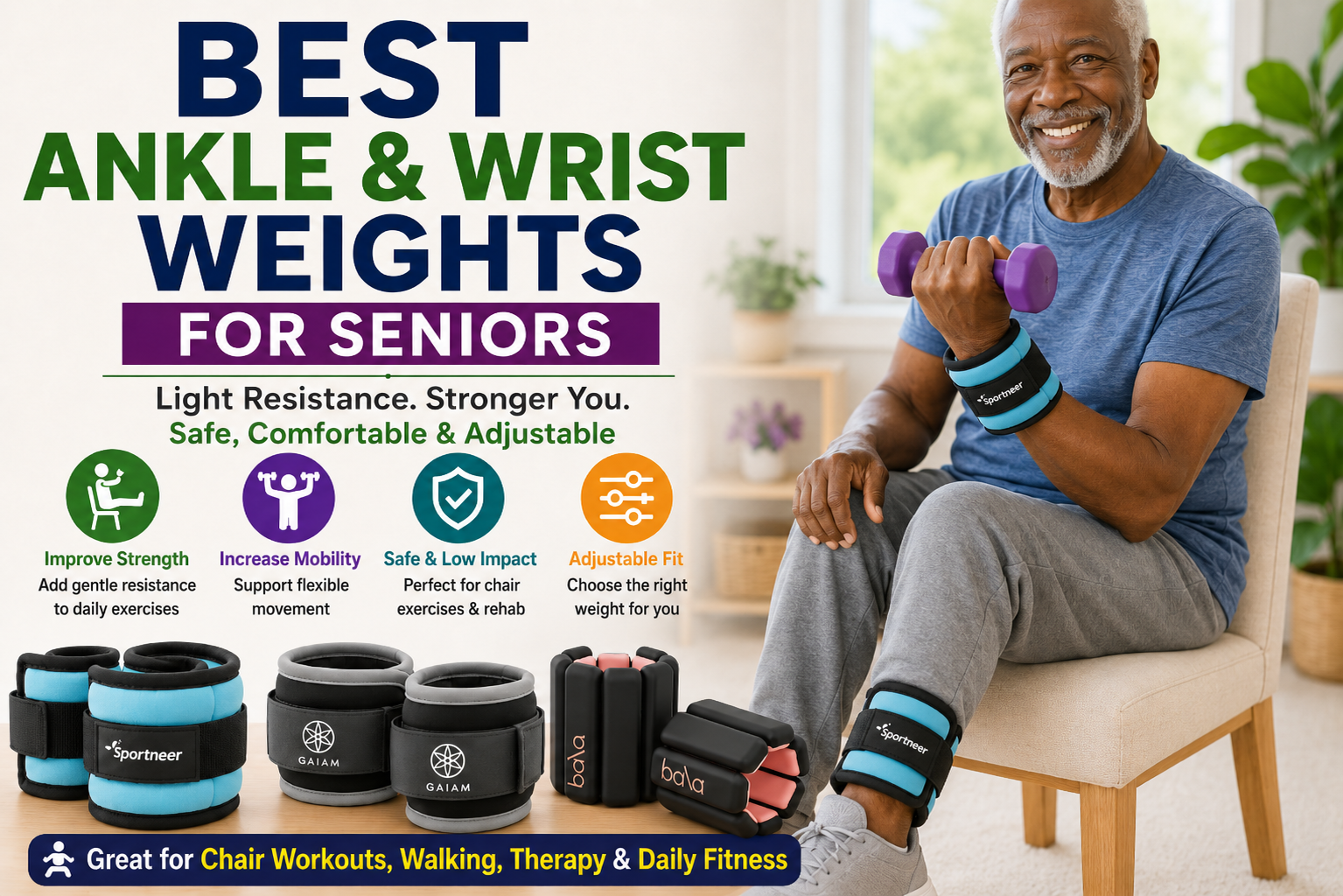
Best Ankle and Wrist Weights for Seniors
As an Amazon Associate, I earn from qualifying purchases.
Ankle and wrist weights can add gentle resistance to chair exercises, seated leg lifts, arm raises, and low-impact workouts at home. For seniors, the best choices are light, comfortable, secure, and easy to put on and take off.
The best ankle and wrist weights for seniors should not feel too heavy or awkward. Many older adults do better with very light resistance instead of heavy weights, especially if they have arthritis, balance concerns, weak legs, shoulder pain, knee pain, hip pain, or limited mobility.
Ankle and wrist weights also fit well with other senior exercise tools. You may also want to see our guides to best chair exercise equipment for seniors, best hand exercisers for seniors with arthritis, best pedal exercisers for seniors, and best transfer boards and transfer aids for seniors.
Quick Picks: Best Ankle and Wrist Weights for Seniors
| Product | Best For | Type |
|---|---|---|
| Sportneer Adjustable Ankle and Wrist Weights | Best overall adjustable option | Adjustable ankle/wrist weights |
| Gaiam Wrist and Ankle Weights | Best soft wearable option | Soft wrist/ankle weights |
| Yes4All Adjustable Wrist and Ankle Weights | Best value adjustable option | Adjustable wrist/ankle weights |
| The Cuff Original Adjustable Ankle and Wrist Weight | Best therapy-style option | Physical therapy ankle/wrist cuff weight |
Best Overall Adjustable Option: Sportneer Adjustable Ankle and Wrist Weights
The Sportneer Adjustable Ankle and Wrist Weights are a good overall choice for seniors who want adjustable resistance for seated leg exercises, chair workouts, and gentle home movement.
Adjustable ankle and wrist weights can be helpful because seniors should usually start light. Instead of buying a fixed weight that may be too heavy, an adjustable pair gives the senior or caregiver more control over how much resistance is used.
This type of wearable weight can be useful for seated leg lifts, seated marches, light arm raises, slow chair exercises, and gentle strengthening. For many seniors, the goal is not to use a lot of weight. The goal is to add a small amount of safe resistance to slow, controlled movement.
Best for: Seniors who want adjustable ankle and wrist weights for chair exercises.
Why seniors may like it:
- Adjustable resistance
- Can be used on ankles or wrists
- Good for seated leg exercises
- Useful for slow, controlled movement
- Can start light and increase slowly
Potential downside: Adjustable weights may have removable inserts, so some seniors may need help changing the weight.
Best Soft Wearable Option: Gaiam Wrist and Ankle Weights
The Gaiam Wrist and Ankle Weights are a good option for seniors who want a softer wearable style instead of a bulkier ankle weight. They are designed to be worn on the wrists or ankles and may be useful for light chair exercises, arm raises, leg movements, and low-impact home workouts.
For seniors, comfort matters. If a weight rubs, slides, or feels scratchy, it is less likely to be used. A softer wearable option may feel better during gentle chair exercises or short exercise sessions.
This style may be a good choice for seniors who want light resistance without a heavy therapy cuff or large adjustable sandbag-style weight.
Best for: Seniors who want a softer wrist and ankle weight option.
Why seniors may like it:
- Can be worn on wrists or ankles
- Soft wearable design
- Good for light chair exercises
- Useful for gentle arm and leg movement
- Less bulky than many traditional weights
Potential downside: Some versions may still be too heavy for beginners, so choose the lightest option that fits the senior’s ability.
Best Value Adjustable Option: Yes4All Adjustable Wrist and Ankle Weights
The Yes4All Adjustable Wrist and Ankle Weights are a good value option for seniors who want adjustable wearable weights for home exercise. They can be used on the wrists or ankles depending on the exercise and fit.
This type of product may be helpful for seniors who want one pair of weights that can work for both upper-body and lower-body movements. For example, wrist use may help with light seated arm raises, while ankle use may help with slow seated leg lifts.
The key for seniors is to start with very light resistance. More weight is not always better, especially if the senior has joint pain, balance concerns, or limited mobility.
Best for: Seniors who want an adjustable wrist and ankle weight pair at a good value.
Why seniors may like it:
- Adjustable design
- Can be used on wrists or ankles
- Good for chair exercises
- Useful for light home workouts
- Simple option for adding gentle resistance
Potential downside: Make sure to choose a light enough version. Some weight options may be too heavy for many seniors.
Best Therapy-Style Option: The Cuff Original Adjustable Ankle and Wrist Weight
The Cuff Original Adjustable Ankle and Wrist Weight is a therapy-style cuff weight often used for physical therapy, rehabilitation, and controlled exercise. It can be worn on the wrist or ankle and is available in different weight levels.
This style may be useful when a doctor, physical therapist, or occupational therapist recommends a specific amount of resistance for controlled movement. It is more of a rehab-style option than a trendy fitness weight.
For seniors who are doing therapy-style seated exercises, this type of cuff weight may be a practical choice. It is especially useful when the goal is slow, careful movement instead of fast exercise.
Best for: Seniors who want a physical therapy-style ankle or wrist weight.
Why seniors may like it:
- Common physical therapy style
- Can be used on wrist or ankle
- Good for controlled rehab-style exercises
- Useful when a specific weight is recommended
- Simple, practical design
Potential downside: Pick the correct weight carefully. Many seniors should start very light.
What Are Ankle and Wrist Weights?
Ankle and wrist weights are wearable weights that strap around the ankles or wrists. They add resistance to simple movements, such as seated leg lifts, arm raises, side leg movements, seated marches, or chair exercises.
For seniors, the goal is not to use the heaviest weights. The goal is to add safe, gentle resistance without causing pain, strain, or balance problems.
Who Should Consider Ankle and Wrist Weights?
Ankle and wrist weights may be helpful for seniors who:
- Do chair exercises
- Want light resistance training
- Need gentle seated arm or leg movement
- Have decent control of the movement
- Want to make simple exercises slightly harder
- Already tolerate bodyweight exercises well
- Have guidance from a doctor or therapist when needed
If the senior is just starting exercise, see our guide to best chair exercise equipment for seniors for lower-impact equipment options.
Who Should Be Careful with Ankle and Wrist Weights?
Ankle and wrist weights are not right for every senior. Be careful if the senior has:
- Knee pain
- Hip pain
- Ankle pain
- Shoulder pain
- Elbow pain
- Wrist pain
- Back pain
- Balance problems
- Recent surgery
- Recent falls
- Unstable walking
- Pain that gets worse with exercise
If there is any doubt, ask a doctor, physical therapist, or occupational therapist before using wearable weights.
How to Choose the Best Ankle and Wrist Weights for Seniors
Start Light
For many seniors, 1 pound or less per wrist or ankle is enough to start. Heavy weights can strain joints or change movement patterns.
Choose Adjustable Weights When Possible
Adjustable weights let the senior start light and slowly increase if safe. This is better than being stuck with a weight that is too heavy.
Look for Comfortable Straps
The weights should feel secure without digging into the skin. Soft fabric or padded straps may feel better than rough materials.
Make Sure They Stay in Place
Weights that slide around can be distracting and unsafe. Look for secure closures and a snug fit.
Use Them for Slow, Controlled Movement
Ankle and wrist weights are best for slow exercises like seated leg lifts, arm raises, seated marches, and therapy-style movements. Avoid fast swinging motions.
Think About Storage
Small weights are easy to misplace. Keep them in a basket near the chair or exercise area.
Safety Tips for Seniors Using Ankle and Wrist Weights
- Start with very light resistance.
- Use a sturdy chair for seated exercises.
- Stop if there is joint pain, dizziness, or shortness of breath.
- Do not use weights if they change balance or walking form.
- Avoid fast swinging motions.
- Move slowly and with control.
- Do not wear ankle weights all day.
- Ask a doctor or therapist if the senior has pain, recent surgery, or fall risk.
Ankle Weights vs. Wrist Weights
Ankle weights are usually used for lower-body exercises like seated leg lifts, side leg raises, marches, and gentle hip or knee movements.
Wrist weights are usually used for upper-body exercises like arm raises, shoulder movements, seated punches, and light arm strengthening.
Some products can be used on either wrists or ankles. These are often useful for seniors because they give more flexibility.
Are Ankle Weights Safe for Walking?
Some people use ankle weights while walking, but seniors should be careful. Walking with ankle weights can change stride, stress the joints, or affect balance. For many seniors, it is safer to use ankle weights for slow seated exercises instead of walking.
If a senior wants to use ankle weights while walking, it is best to ask a doctor, physical therapist, or trainer first.
Best Overall Pick
For most seniors, the Sportneer Adjustable Ankle and Wrist Weights are the best place to start because the resistance can be adjusted and used for slow seated leg and arm exercises.
If the senior wants a softer wearable option, the Gaiam Wrist and Ankle Weights may be a better fit. If value is most important, the Yes4All Adjustable Wrist and Ankle Weights are worth considering. If the senior needs a physical therapy-style option, The Cuff Original Adjustable Ankle and Wrist Weight may be the best choice.
Related Senior Exercise and Therapy Guides
- Best Chair Exercise Equipment for Seniors
- Best Hand Exercisers for Seniors with Arthritis
- Best Pedal Exercisers for Seniors
- Best Transfer Boards and Transfer Aids for Seniors
- Best Lift Chairs for Seniors
- Best Rollator Walkers for Seniors
Frequently Asked Questions
What are the best ankle and wrist weights for seniors?
The best ankle and wrist weights for most seniors are light, comfortable, secure, and easy to use. Adjustable weights are helpful because the senior can start light and increase slowly if safe.
Are ankle weights good for seniors?
Ankle weights can be useful for some seniors during slow seated exercises, but they are not right for everyone. Seniors with joint pain, balance problems, recent surgery, or fall risk should ask a healthcare professional first.
How heavy should ankle weights be for seniors?
Many seniors should start very light, often around 1 pound or less per ankle. More weight is not always better. Comfort, safety, and good movement matter more.
Can seniors use wrist weights?
Yes, some seniors can use light wrist weights for seated arm exercises. They should avoid fast swinging motions and stop if the shoulders, wrists, or elbows hurt.
Are adjustable ankle weights better?
Adjustable ankle weights are often better for seniors because they allow a lighter starting point and gradual increases only if the movement feels safe.
Should seniors wear ankle weights while walking?
Many seniors should avoid walking with ankle weights unless a doctor or physical therapist says it is safe. Ankle weights can change walking form and may increase joint strain or balance risk.
Final Thoughts
The best ankle and wrist weights for seniors can add gentle resistance to chair exercises, seated leg lifts, arm raises, and low-impact home workouts. For older adults who want to build strength safely, light wearable weights can be a useful tool.
For most seniors, start with very light resistance and use the weights during slow, controlled movements. Avoid heavy weights, fast movements, or walking with ankle weights if balance or joint pain is a concern.
Before buying, think about the senior’s strength, balance, joint comfort, exercise goals, and whether a doctor or physical therapist should help choose the safest resistance level.