
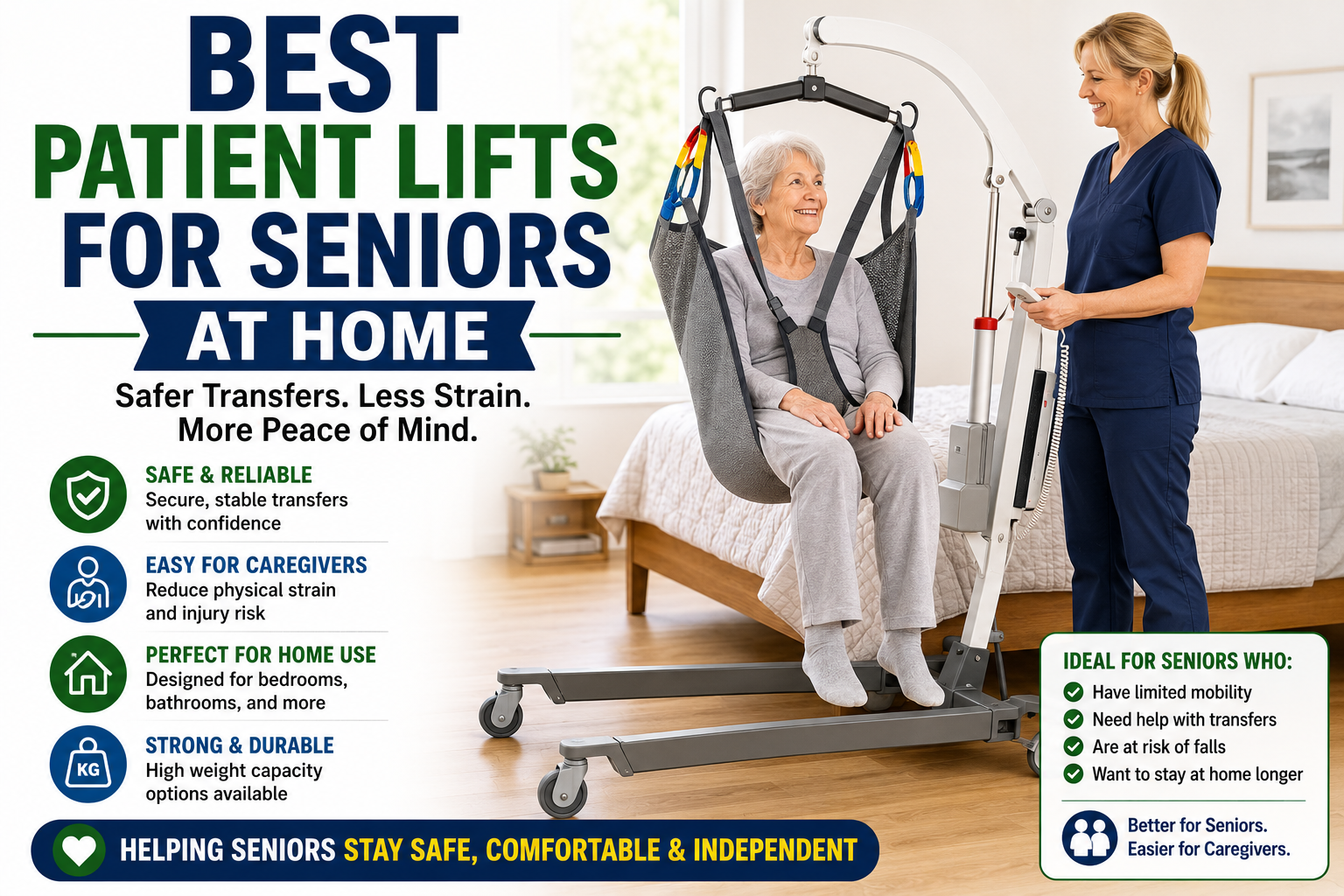
Best Patient Lifts for Seniors at Home
As an Amazon Associate, I earn from qualifying purchases.
A patient lift can help caregivers transfer a senior from a bed, wheelchair, recliner, chair, commode, or floor more safely. These lifts are often used when a senior has very limited mobility, cannot stand safely, or needs more support than a caregiver can provide by hand.
The best patient lifts for seniors at home are sturdy, properly rated for the user’s weight, compatible with the right sling, and practical for the home layout. Some are manual hydraulic lifts, some are electric full-body lifts, and some are transfer chair-style lifts used for short moves between nearby surfaces.
Patient lifts also work well with other senior mobility and transfer tools. You may also want to see our guides to best transfer boards and transfer aids for seniors, best bed assist handles for seniors, best bed rails for seniors, and best lift chairs for seniors.
Quick Picks: Best Patient Lifts for Seniors at Home
| Product | Best For | Type |
|---|---|---|
| Vive Patient Lift for Home Use | Best overall hydraulic lift | Manual hydraulic patient lift |
| ProHeal Hydraulic Patient Lift | Best heavy-duty manual lift | Manual full-body patient lift |
| Hi-Fortune Electric Patient Lift | Best electric option | Battery-powered full-body lift |
| ProHeal Electric Patient Lift | Best premium electric lift | Electric full-body transfer lift |
| Invacare Hydraulic Patient Lift | Best well-known brand option | Manual hydraulic patient lift |
| Electric Patient Lift Transfer Chair | Best transfer chair style | Electric transfer lift chair |
Best Overall Hydraulic Lift: Vive Patient Lift for Home Use
The Vive Patient Lift for Home Use is a strong overall choice for families who want a hydraulic patient lift for home transfers. It is designed to help move a senior between a bed, chair, wheelchair, or floor with caregiver assistance.
This type of lift may be helpful when a senior cannot safely stand, pivot, or transfer with only a transfer board or gait belt. A full-body lift can reduce strain on caregivers and may make transfers safer when used correctly.
The Vive listing describes a 400-pound weight capacity and a portable medical hoist design for elderly, handicap, and senior users.
Best for: Families who want a manual hydraulic patient lift for home use.
Why seniors and caregivers may like it:
- Hydraulic lift design for home transfers
- Can help with bed, chair, wheelchair, and floor transfers
- Useful for seniors with very limited mobility
- May reduce caregiver lifting strain
- Designed for home use
Potential downside: A manual hydraulic lift still requires caregiver effort and careful setup.
Best Heavy-Duty Manual Lift: ProHeal Hydraulic Patient Lift
The ProHeal Hydraulic Patient Lift is a good choice for caregivers who want a sturdy manual full-body lift. The listing describes it as a manual full-body lifter for handicapped, senior, and immobile patients with a 450-pound capacity.
A hydraulic patient lift can be useful for homes where a caregiver needs to move a senior from bed to chair, wheelchair to bed, or chair to commode. It can also be useful when the senior cannot safely bear weight.
This may be a better option than a transfer board when the senior cannot help enough with the transfer.
Best for: Seniors who need a higher-capacity manual patient lift.
Why seniors and caregivers may like it:
- Manual hydraulic full-body lift
- Higher weight capacity than many basic lifts
- Designed for immobile or limited-mobility users
- Can support bed, chair, and wheelchair transfers
- Useful for home or care settings
Potential downside: It is larger than smaller transfer aids and may not fit easily in tight rooms.
Best Electric Option: Hi-Fortune Electric Patient Lift
The Hi-Fortune Electric Patient Lift is a good option for families who want battery-powered lifting instead of manual hydraulic pumping. The listing describes it as an electric body transfer lift for home use with a 400-pound weight capacity and medium U-sling.
An electric patient lift may be easier for some caregivers because the motor does much of the lifting work. This can be helpful when transfers happen several times a day.
It may be useful for bed-to-wheelchair transfers, wheelchair-to-chair transfers, and other full-body transfer needs when used with the correct sling and caregiver supervision.
Best for: Caregivers who want electric lifting assistance.
Why seniors and caregivers may like it:
- Battery-powered electric lifting
- Can reduce manual pumping effort
- Includes medium U-sling in the listing
- Designed for home use
- Good for repeated daily transfers
Potential downside: Electric lifts need battery charging and may cost more than manual hydraulic lifts.
Best Premium Electric Lift: ProHeal Electric Patient Lift
The ProHeal Electric Patient Lift is a premium option for seniors who need a full-body electric transfer lift. The listing describes it as a safe and easy full-body patient transfer lifter for home use and facilities, with floor, low bed, and chair lifting.
This type of lift may be appropriate when a senior needs frequent transfers and the caregiver wants more powered assistance than a manual hydraulic lift provides.
It may also be useful in homes where the senior needs help from a low bed, wheelchair, chair, or floor-level position.
Best for: Families who want a higher-capacity premium electric patient lift.
Why seniors and caregivers may like it:
- Electric full-body lift design
- Designed for home and facility use
- Can assist with floor, low bed, and chair lifting
- May reduce caregiver strain
- Useful for frequent transfers
Potential downside: It is more expensive than many manual patient lifts.
Best Well-Known Brand Option: Invacare Hydraulic Patient Lift
The Invacare Hydraulic Patient Lift is a well-known manual patient lift option. The Amazon listing describes a lightweight transfer lift chair with a 450-pound weight capacity, bent mast, 6-point padded swivel bar, and floor-to-bed height range.
Invacare is a recognized name in home medical equipment, which may give some caregivers more confidence when choosing a patient lift.
This lift may be useful for seniors who need full-body transfer help and caregivers who prefer a manual hydraulic lift from a well-known brand.
Best for: Caregivers who prefer a recognized patient lift brand.
Why seniors and caregivers may like it:
- Well-known medical equipment brand
- Manual hydraulic lifting
- High listed weight capacity
- Designed for patient transfers
- Useful for bed, chair, and wheelchair transfer needs
Potential downside: Manual operation still requires caregiver involvement and proper training.
Best Transfer Chair Style: Electric Patient Lift Transfer Chair
The Electric Patient Lift Transfer Chair is a different style of transfer aid. Instead of a traditional full-body hoist, this type of device works more like a transfer chair that can help move a senior between nearby surfaces.
The listing describes a foldable electric transfer lift wheelchair for home, car, and bathroom use with adjustable height and base width.
This type of device may be useful for certain seated transfers, but it is not the same as a full-body patient hoist. Always check whether the senior can sit upright and whether the device fits the bathroom, bed, car, or wheelchair setup.
Best for: Seniors who need seated transfer help and can safely use a transfer chair-style lift.
Why seniors and caregivers may like it:
- Transfer chair-style design
- Electric lifting assistance
- Foldable design may help with storage
- May help with home, bathroom, or car transfers
- Different option from a full-body hoist
Potential downside: It is not appropriate for every senior, especially someone who cannot sit upright safely.
What Is a Patient Lift?
A patient lift is a mobility device that helps transfer a person who cannot safely move from one surface to another on their own. It may be used to move a senior from a bed to a wheelchair, wheelchair to recliner, chair to commode, or floor to bed.
Most full-body patient lifts use a sling that supports the senior during the transfer. The caregiver operates the lift and guides the transfer carefully.
Who Should Consider a Patient Lift?
A patient lift may be helpful for seniors who:
- Cannot safely stand or pivot
- Have very limited mobility
- Need full-body transfer support
- Have a high fall risk during transfers
- Need caregiver help moving from bed to wheelchair
- Need help after a stroke, injury, illness, or surgery
- Are too difficult or unsafe for a caregiver to lift manually
If the senior can still help with transfers, a transfer board or transfer aid may be enough. If the senior cannot safely assist, a patient lift may be more appropriate.
Types of Patient Lifts for Seniors
Manual Hydraulic Patient Lifts
Manual hydraulic lifts use a pump handle to raise and lower the senior. They are usually less expensive than electric lifts, but they require more caregiver effort.
Electric Patient Lifts
Electric lifts use a motor and battery to raise and lower the user. They may be easier for caregivers during repeated daily transfers, but they cost more and need charging.
Transfer Chair-Style Lifts
Transfer chair-style lifts may help with seated transfers between nearby surfaces. They are not the same as full-body hoist lifts and may not work for seniors who cannot sit upright safely.
Sit-to-Stand Lifts
Sit-to-stand lifts are for seniors who can bear some weight and participate in the transfer. They are not ideal for completely immobile users.
How to Choose the Best Patient Lift for Seniors at Home
Check the Weight Capacity
Always choose a lift that supports the senior’s weight. Do not guess. Check the manufacturer’s stated weight capacity before buying.
Measure Doorways and Room Space
Patient lifts can be large. Make sure the base fits through doorways and around beds, chairs, wheelchairs, and bathroom areas.
Choose the Right Sling
The sling is just as important as the lift. Make sure the sling size, shape, and connection style match the lift and the senior’s needs.
Decide Between Manual and Electric
Manual lifts may cost less. Electric lifts may be easier for caregivers. Consider how often transfers happen each day.
Think About Floor and Carpet
Patient lifts roll better on some surfaces than others. Thick carpet, narrow hallways, and small bathrooms can make transfers harder.
Ask a Professional When Needed
A doctor, physical therapist, occupational therapist, or home health professional can help decide which lift and sling are safest.
Safety Tips for Using Patient Lifts
- Read the full instruction manual before use.
- Make sure the caregiver is trained before transferring the senior.
- Check the lift’s weight capacity.
- Use the correct sling size and type.
- Inspect sling straps and lift parts before each use.
- Lock or position equipment according to the manufacturer’s directions.
- Move slowly and communicate with the senior during transfers.
- Do not use a patient lift if any parts look damaged.
- Ask a healthcare professional if you are unsure which lift is appropriate.
Patient Lift vs. Transfer Board
A transfer board is usually used when the senior can help slide from one surface to another.
A patient lift is used when the senior needs more full-body support and cannot safely transfer with a board or caregiver assistance alone.
If the senior still has some strength and balance, a transfer board may be simpler. If the senior cannot safely bear weight or assist, a patient lift may be the safer choice.
Best Overall Pick
For most families looking for a manual home option, the Vive Patient Lift for Home Use is a good place to start because it is designed for home transfers and has a hydraulic full-body lift design.
If you want powered lifting, the Hi-Fortune Electric Patient Lift or ProHeal Electric Patient Lift may be better options. If you prefer a well-known brand, the Invacare Hydraulic Patient Lift is also worth considering.
Related Senior Mobility and Transfer Guides
- Best Transfer Boards and Transfer Aids for Seniors
- Best Bed Assist Handles for Seniors
- Best Bed Rails for Seniors
- Best Lift Chairs for Seniors
- Best Lightweight Wheelchairs for Seniors
- Best Bedside Commodes for Seniors
Frequently Asked Questions
What is the best patient lift for seniors at home?
The best patient lift depends on the senior’s weight, mobility level, transfer needs, home layout, and caregiver strength. A hydraulic full-body lift may work well for many homes, while electric lifts may be better for frequent daily transfers.
Are patient lifts safe for home use?
Patient lifts can be safe when properly selected, correctly assembled, used with the right sling, and operated by a trained caregiver. Improper use can be dangerous, so training and instructions matter.
What is the difference between a manual and electric patient lift?
A manual lift uses a hydraulic pump handle. An electric lift uses battery-powered lifting. Electric lifts may reduce caregiver effort, while manual lifts are usually less expensive.
Can one caregiver use a patient lift alone?
Some patient lifts may be operated by one trained caregiver, but this depends on the lift, the senior’s condition, and the transfer situation. Follow the manufacturer’s instructions and professional guidance.
Do patient lifts come with slings?
Some patient lifts include a sling, and others do not. Always check the product listing and make sure the sling is the right size and compatible with the lift.
Can a patient lift help after a fall?
Some patient lifts are designed to help lift a person from the floor, but not all are. If falls are a concern, check the lift’s floor-lift range and ask a healthcare professional.
Final Thoughts
The best patient lifts for seniors at home can make transfers safer, easier, and less physically demanding for caregivers. For seniors with very limited mobility, a patient lift may be a better option than manual lifting, transfer boards, or unsafe assisted transfers.
For many homes, a manual hydraulic patient lift is a practical starting point. For frequent transfers, an electric lift may be worth the extra cost. For seated transfers, a transfer chair-style lift may work for some seniors, but only if they can sit upright safely.
Before buying, check the senior’s weight, transfer needs, sling compatibility, room layout, doorway width, floor surfaces, and caregiver ability. When in doubt, ask a physical therapist, occupational therapist, doctor, or home health professional for guidance.