
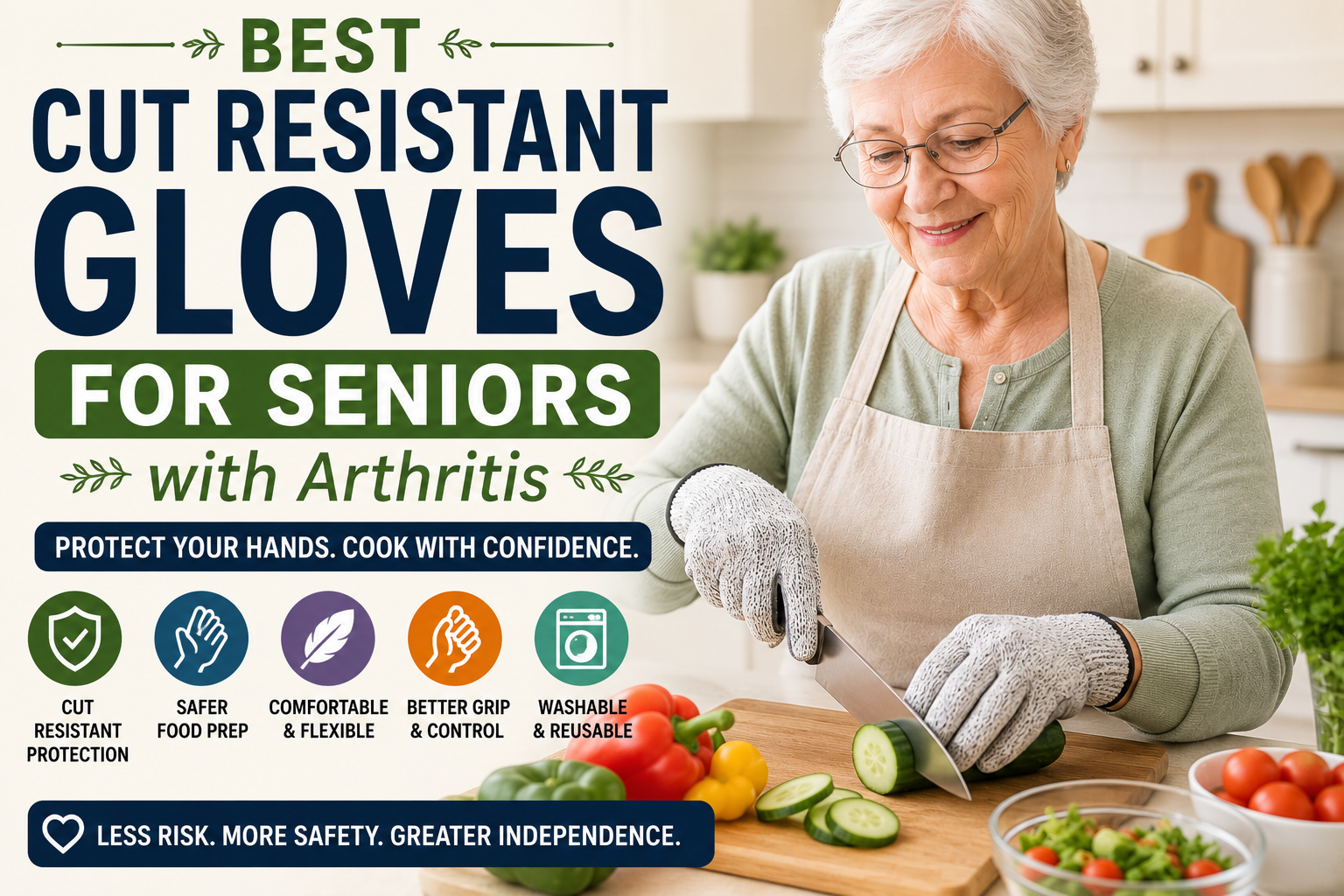
Best Cut Resistant Gloves for Seniors with Arthritis
Best cut resistant gloves for seniors with arthritis can help older adults protect their hands while slicing vegetables, using a mandoline, grating cheese, peeling fruit, cutting meat, or preparing everyday meals.
For many seniors, cooking becomes harder because of weak hands, shaky grip, slower reaction time, arthritis pain, or fear of slipping with a knife. A good pair of cut resistant gloves can add an extra layer of protection during food prep.
These gloves do not make someone completely injury-proof, and seniors should still use knives carefully. But they can help reduce the risk of small cuts and make kitchen tasks feel less stressful.
Cut resistant gloves also work well with other senior-friendly kitchen tools like adaptive cutting boards for seniors, easy-grip vegetable peelers for seniors with arthritis, rocker knives for seniors with arthritis, lightweight cookware for seniors with arthritis, and easy-grip utensils for seniors with arthritis.
As an Amazon Associate, I earn from qualifying purchases.
Quick Picks: Best Cut Resistant Gloves for Seniors with Arthritis
| Product | Best For | Type |
|---|---|---|
| NoCry Premium Cut Resistant Gloves | Best overall cut resistant gloves | Level 5 kitchen gloves |
| Dowellife Level 8 Reinforced Cut Resistant Gloves | Best reinforced protection | Reinforced cut gloves |
| Evridwear Level 5 Cut Resistant Gloves | Best multipack-style option | Food-safe cut gloves |
| Schwer SlicePro ANSI A9 Cut Resistant Glove | Best heavy-duty protection | ANSI A9 glove |
| Mkobon Cut Resistant Gloves | Best budget-friendly option | Level 5 protective gloves |
| Glove Station Ultra Durable Cut Resistant Gloves | Best extra kitchen safety option | Food-grade cut gloves |
1. NoCry Premium Cut Resistant Gloves
Best for: Seniors who want a popular everyday kitchen safety glove for slicing, chopping, grating, and mandoline use.
NoCry Premium Cut Resistant Gloves are a strong overall choice for seniors with arthritis because they are designed to protect the hands while still allowing flexibility during kitchen tasks.
For older adults who feel nervous using knives or graters, this type of glove can help add confidence. It may be especially useful when slicing vegetables, using a box grater, cutting fruit, or working with a mandoline slicer.
These gloves are lightweight compared with metal mesh gloves, which can make them easier for seniors with weak hands to wear during regular meal prep.
Why seniors may like it
- Good everyday kitchen safety option
- Helpful for slicing, grating, peeling, and mandoline use
- Lightweight and flexible
- May help seniors feel more confident with knives
- Useful for seniors with arthritis or shaky hands
Possible downside: These gloves are cut resistant, not cut proof. Seniors still need to use knives carefully.
Best choice for: Seniors who want one simple pair of kitchen cutting gloves.
2. Dowellife Level 8 Reinforced Cut Resistant Gloves
Best for: Seniors who want reinforced protection for tougher kitchen prep.
The Dowellife Level 8 Reinforced Cut Resistant Gloves are a good choice for seniors who want extra protection for higher-risk kitchen tasks like meat cutting, oyster shucking, mandoline slicing, or handling sharper tools.
For seniors with arthritis, the benefit is not just protection. The gloves may also help reduce fear during food prep. When someone is worried about slipping with a knife, they may grip harder or move awkwardly, which can make cooking feel even more difficult.
A reinforced glove may be helpful for seniors who still cook often and want a little more peace of mind.
Why seniors may like it
- Reinforced cut-resistant design
- Useful for higher-risk kitchen tasks
- Helpful for mandoline slicing and meat prep
- Can add confidence during food preparation
- Good option for seniors who still cook regularly
Possible downside: Reinforced gloves may feel thicker than basic lightweight cut resistant gloves.
Best choice for: Seniors who want more protection than a basic kitchen cutting glove.
3. Evridwear Level 5 Cut Resistant Gloves
Best for: Seniors who want flexible food-safe gloves for everyday meal prep.
Evridwear Level 5 Cut Resistant Gloves are another good option for seniors who want a lightweight glove for chopping, slicing, peeling, and grating.
This type of glove can be useful for seniors who prepare fruits and vegetables often. It can also be helpful when using kitchen tools that feel risky, such as a mandoline, box grater, or sharp vegetable peeler.
For seniors with arthritis, a glove that still allows finger movement is important. If a glove is too stiff, it can make food prep harder instead of easier.
Why seniors may like it
- Good for everyday kitchen prep
- Helpful for slicing fruits and vegetables
- Flexible enough for many cooking tasks
- Can help reduce small cut risks
- Useful with peelers, graters, and knives
Possible downside: Seniors should choose the right size so the glove does not feel loose or awkward.
Best choice for: Seniors who want flexible kitchen gloves for regular use.
4. Schwer SlicePro ANSI A9 Cut Resistant Glove
Best for: Seniors who want heavy-duty protection for very sharp kitchen tasks.
The Schwer SlicePro ANSI A9 Cut Resistant Glove is a heavier-duty option for seniors who want stronger protection than a basic fabric cutting glove.
This type of glove may be useful for tasks like meat cutting, fish prep, oyster shucking, or working with very sharp tools. It may also be helpful for caregivers who prepare food for seniors and want extra hand protection.
Because it is more protective, it may feel different than a soft fabric glove. Seniors should balance protection with comfort and ease of movement.
Why seniors may like it
- Heavy-duty protection
- Good for sharper kitchen tasks
- Useful for meat, fish, and oyster prep
- May feel steadier for high-risk cutting jobs
- Good option for serious kitchen safety
Possible downside: A heavy-duty glove may feel bulkier or less comfortable for simple everyday chopping.
Best choice for: Seniors or caregivers who need stronger cut protection for tougher food prep.
5. Mkobon Cut Resistant Gloves
Best for: Seniors who want an affordable cut resistant glove option.
Mkobon Cut Resistant Gloves may be a good budget-friendly option for seniors who want basic hand protection for meal prep without spending much.
These gloves can be helpful for tasks like chopping vegetables, peeling fruit, slicing potatoes, or using a grater. For seniors who only cook occasionally, a lower-cost pair may be enough.
The key is fit. Seniors with arthritis should avoid gloves that are too loose because extra fabric can get in the way while cutting.
Why seniors may like it
- Budget-friendly option
- Good for simple kitchen prep
- Helpful for slicing, peeling, and grating
- Useful starter pair
- Can add confidence while cooking
Possible downside: Budget gloves may not feel as durable or comfortable as higher-end options.
Best choice for: Seniors who want an inexpensive pair of cut resistant kitchen gloves.
6. Glove Station Ultra Durable Cut Resistant Gloves
Best for: Seniors who want another food-grade kitchen glove option for cutting tasks.
Glove Station Ultra Durable Cut Resistant Gloves are another option for seniors who want extra protection while cooking. They can be used for chopping, slicing, BBQ prep, and other kitchen tasks where hand protection matters.
For seniors with arthritis, the best glove is not always the thickest glove. It should be protective, but also comfortable enough to actually wear. A glove that sits unused in a drawer will not help.
This option may work well for seniors who want a pair of food-grade cut resistant gloves for general kitchen use.
Why seniors may like it
- Food-grade kitchen glove option
- Useful for chopping and slicing
- Can help protect hands during meal prep
- Good for seniors who still cook regularly
- Helpful for knife and grater tasks
Possible downside: Seniors should check sizing carefully before ordering.
Best choice for: Seniors who want a backup option for kitchen cutting safety.
Why Cut Resistant Gloves Help Seniors with Arthritis
Cut resistant gloves can help seniors with arthritis by adding protection during tasks that require knives, slicers, peelers, or graters.
They may be helpful for seniors who have:
- Arthritis in the hands or wrists
- Weak grip strength
- Hand tremors
- Slow reaction time
- Thumb pain
- Wrist pain
- Fear of slipping with a knife
- Difficulty holding fruits or vegetables steady
These gloves can be especially helpful when used with an adaptive cutting board, because the cutting board helps hold food in place while the glove helps protect the hand.
Best Kitchen Tasks for Cut Resistant Gloves
Using a mandoline slicer
Mandoline slicers can be risky because the blade is very sharp. Cut resistant gloves can add protection when slicing potatoes, cucumbers, onions, carrots, or zucchini.
Grating cheese or vegetables
Box graters can scrape fingers quickly. Gloves can help protect the fingertips while grating cheese, carrots, potatoes, or cabbage.
Peeling fruits and vegetables
Peelers can slip, especially if the senior has weak hands or wet fingers. Gloves can provide extra protection during peeling.
Chopping vegetables
Cut resistant gloves can help seniors feel safer when chopping onions, peppers, celery, apples, or other foods.
Cutting meat or fish
For seniors who prepare meat or fish, a cut resistant glove can help protect the hand that holds the food steady.
How to Choose the Best Cut Resistant Gloves for Seniors
1. Choose the right size
Fit is very important. Gloves that are too loose can bunch up and make cutting harder. Gloves that are too tight can be uncomfortable for arthritic hands.
2. Look for flexibility
Seniors need to be able to move their fingers. A glove that feels too stiff may be frustrating and may not get used.
3. Consider the protection level
Most kitchen gloves use cut resistance ratings. Higher protection may be useful for sharp tools, but thicker gloves may reduce comfort and dexterity.
4. Choose food-safe gloves
For kitchen use, choose gloves made for food preparation. Avoid work gloves that are not meant for touching food.
5. Make sure they are easy to clean
Kitchen gloves should be washable. Seniors should follow the product instructions for cleaning and drying.
6. Pick gloves the senior will actually wear
The best glove is the one that is comfortable enough to use regularly. If it is too bulky, too hot, or too difficult to put on, it may stay in the drawer.
Cut Resistant Gloves vs. Adaptive Cutting Boards
Cut resistant gloves and adaptive cutting boards solve different problems.
Choose cut resistant gloves if the senior:
- Worries about cutting their fingers
- Uses knives, graters, peelers, or mandolines
- Still has enough control to cut food safely
- Wants added protection during food prep
Choose an adaptive cutting board if the senior:
- Has trouble holding food steady
- Needs one-handed food prep help
- Has weak grip or limited hand control
- Needs spikes, clamps, or raised corners to stabilize food
For many seniors, the safest setup is both: an adaptive cutting board to hold food steady and a cut resistant glove to protect the hand.
Important Safety Tips
- Cut resistant gloves are not completely cut proof.
- Do not intentionally test gloves with a knife while wearing them.
- Keep knives sharp, because dull knives can slip more easily.
- Use a stable cutting board on a non-slip surface.
- Do not use gloves near open flames.
- Wash gloves after handling raw meat, poultry, or fish.
- Replace gloves if they are damaged, torn, or stretched out.
- Use extra caution with mandoline slicers and graters.
Best Senior-Friendly Food Prep Setup
A safer kitchen setup for seniors with arthritis may include:
- Cut resistant gloves
- An adaptive cutting board
- Easy-grip vegetable peelers
- A rocker knife
- Lightweight cookware
- Non-slip placemats
- Easy-grip utensils
- Good lighting over the counter
For more kitchen safety ideas, see our guides to easy-grip vegetable peelers, rocker knives, and lightweight cookware for seniors with arthritis.
Related Senior Kitchen Guides
- Best Adaptive Cutting Boards for Seniors
- Best Easy-Grip Vegetable Peelers for Seniors with Arthritis
- Best Rocker Knives for Seniors with Arthritis
- Best Lightweight Cookware for Seniors with Arthritis
- Best Easy-Grip Utensils for Seniors with Arthritis
- Best Jar Openers for Seniors with Arthritis
- Best Electric Can Openers for Seniors with Arthritis
- Best Lightweight Dishes for Seniors with Arthritis
- Best Adaptive Bowls for Seniors with Arthritis
Frequently Asked Questions
What are the best cut resistant gloves for seniors with arthritis?
The best cut resistant gloves for seniors with arthritis are gloves that are food-safe, flexible, easy to put on, and properly sized. Lightweight Level 5 kitchen gloves are a good starting point for many seniors, while heavier-duty gloves may be better for tougher cutting tasks.
Are cut resistant gloves good for seniors?
Yes, cut resistant gloves can be helpful for seniors who still cook but worry about cutting their fingers while slicing, peeling, grating, or using a mandoline slicer.
Do cut resistant gloves prevent all cuts?
No. Cut resistant gloves reduce risk, but they do not make someone completely protected. Seniors should still use knives, graters, and slicers carefully.
Can seniors use cut resistant gloves with a mandoline?
Yes, cut resistant gloves can be useful with a mandoline slicer, but seniors should still use the mandoline guard and follow all safety instructions.
Are cut resistant gloves washable?
Many cut resistant gloves are washable, but cleaning instructions vary. Always check the product label or Amazon listing before washing.
Should seniors wear one glove or two?
Many seniors only need the glove on the hand holding the food. However, some prefer wearing both gloves for extra confidence.
What size cut resistant gloves should seniors buy?
Seniors should choose a snug but comfortable size. Gloves that are too loose can make cutting harder, while gloves that are too tight may bother arthritic hands.
What other tools help seniors cut food safely?
Helpful tools include adaptive cutting boards, easy-grip peelers, rocker knives, non-slip placemats, lightweight cookware, and good kitchen lighting.
Final Thoughts
The best cut resistant gloves for seniors with arthritis can make food prep feel safer and less stressful. They are especially helpful for slicing vegetables, using graters, peeling fruit, cutting meat, and working with mandoline slicers.
For most seniors, a flexible food-safe cut resistant glove is a good place to start. For tougher jobs, a reinforced or heavy-duty glove may be better. The key is choosing a glove that fits well, feels comfortable, and is easy enough to use regularly.
Pairing cut resistant gloves with an adaptive cutting board, easy-grip peeler, rocker knife, and lightweight cookware can create a much safer and easier kitchen setup for seniors with arthritis.